
Edge AI computing solution purpose-built for the manufacturing industry



DNN EdgeAI+ integrates process parameters with AOI inspection data, using AI algorithms and historical records for Run-to-Run monitoring — autonomously detecting process drift, predicting optimal parameters in real time, and issuing corrective commands directly to equipment to ensure yield and quality on every batch.
Supports SQL/Oracle databases, equipment log parsing, and real-time collection via SECS/GEM and OPC-UA — precisely matching metrology results to process recipes by Lot ID / Run ID.
AI automatically calculates the optimal recipe and sends it back to the equipment for execution, achieving Run-to-Run closed-loop optimization across three stages: value prediction, parameter recommendation, and self-optimization.
Available in Mini-PC (space-saving) or Server (high-performance compute) form factors, with fully air-gapped operation — process data never leaves the factory.
Displays AI prediction trends, model confidence scores, and optimization trajectories in real time — engineers can review and confirm AI-suggested recipe changes before execution.
Dual-layer protection: AI-side Soft Limits cap the parameter change range, while equipment-side Hard Limits and hardware interlocks ensure equipment cannot be damaged by erroneous commands.
Supports on-site fine-tuning, model version management, and one-click rollback — handling equipment aging and model drift to ensure long-term inference accuracy.
Choose between fully autonomous on-site training (data never leaves the factory) or DNN-assisted training on high-performance internal servers — flexibly configured to match your security requirements and budget.
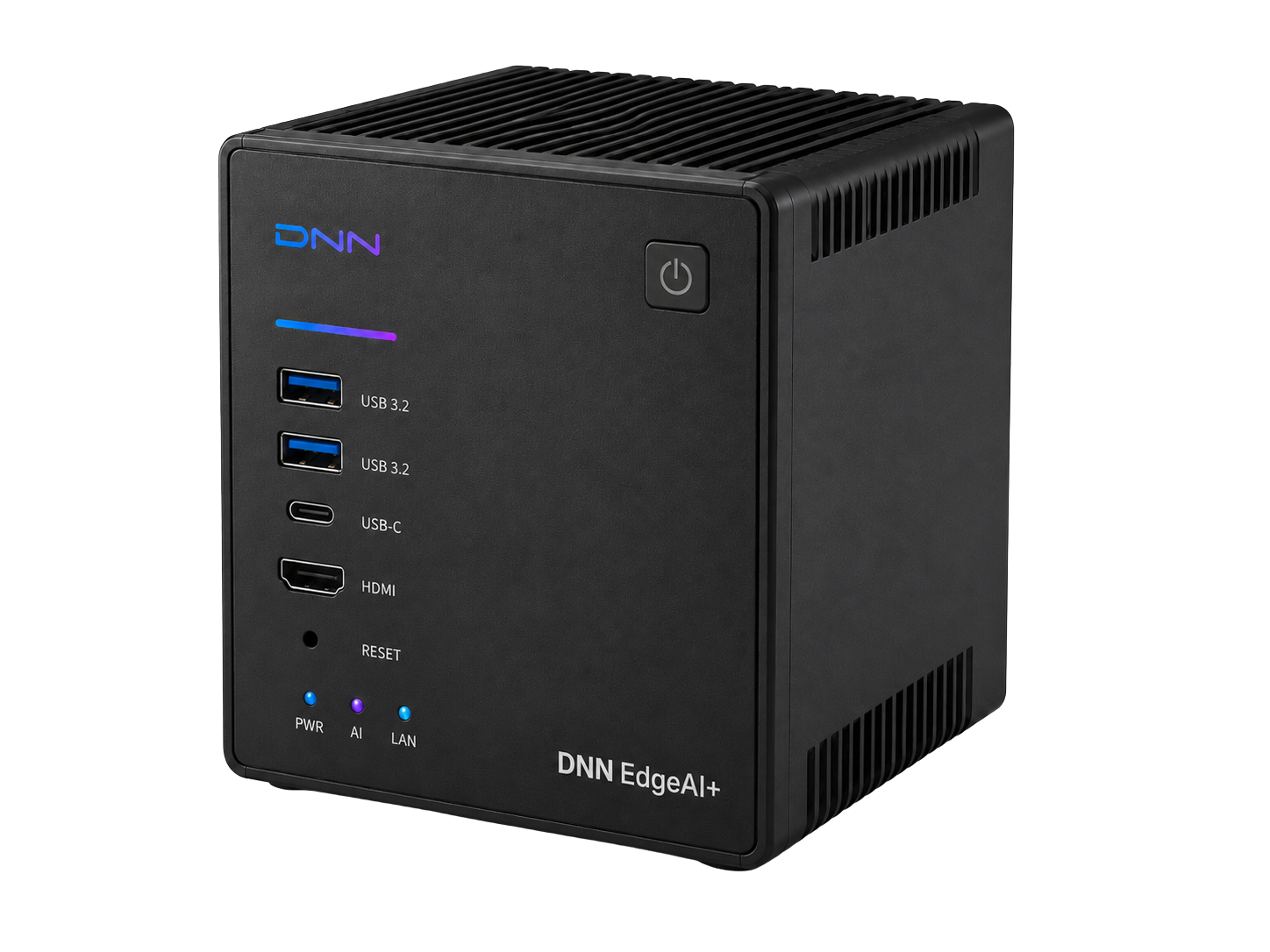
| Spec | DNN EdgeAI+ Lite Entry · Ryzen 5 8645HS |
DNN EdgeAI+ Base Base · Ryzen AI 9 HX 370 |
DNN EdgeAI+ Pro Standard · Ryzen AI Max+ 395 |
DNN EdgeAI+ Max Flagship · Ryzen AI Max+ PRO 395 |
|---|---|---|---|---|
| CPU | Ryzen 5 8645HS (6C/12T, Zen 4) | Ryzen AI 9 HX 370 (12C/24T, Zen 5/5c) | Ryzen AI Max+ 395 (16C/32T) | Ryzen AI Max+ PRO 395 (16C/32T, Zen 5) |
| GPU | Radeon 760M (8 CU, RDNA 3) | Radeon 890M (16 CU, RDNA 3.5) | Radeon 8060S (40 CU) | Radeon 8060S (40 CU, RDNA 3.5) |
| NPU | 16 TOPS (38 TOPS Total)NPU | 50 TOPS (80 TOPS Total)NPU | 50 TOPS (126 TOPS Total)NPU | 50 TOPS (126 TOPS Total)NPU |
| Memory | 16 GB DDR5-5600 SO-DIMM (8 GB option) | 32 GB DDR5-5600 SO-DIMM (up to 64 GB) | 64 GB LPDDR5x-8000 (soldered) | 128 GB LPDDR5x-8000, soldered (112GB VRAM available) |
| Storage | 512 GB M.2 2280 NVMe | 1 TB M.2 2280 NVMe | 1 TB M.2 NVMe × 2 | 2 TB M.2 NVMe + M.2 expansion slot |
| Power | 120W DC adapter | 180W DC adapter | 240W DC adapter | 240W DC adapter (TDP 120W) |
DNN EdgeAI+ trains on your process data, equipment logs, SOPs, and historical anomaly cases to build an Edge AI model exclusive to your production line.
Engineers get instant root-cause analysis, optimal parameter prediction, and traceable corrective guidance.
Learns from process data models with Fine-Tuning
Deployed at the equipment level — from single unit to multi-unit to full line
At inference time, relevant documents are retrieved in real time from an external knowledge base and injected as factual context — ensuring every diagnosis has a traceable, verifiable document source.
Pre-trained models undergo secondary training on semiconductor-specific data using LoRA / QLoRA low-rank adapter techniques — enabling deep understanding of SPC, FDC, Metrology terminology and causal logic.
Fine-Tuning provides domain depth; RAG provides real-time document augmentation. Together they achieve accuracy neither technology can reach alone — producing evidence-backed process diagnosis answers.
Text is mapped to high-dimensional vector space via an embedding model — semantically similar content sits closer together. Chunking strategy directly determines the knowledge base's retrieval precision and recall rate.
Integrating sensor data collection, multivariate neural network inference, real-time parameter feedback, and a visual monitoring interface
Three process scenarios showcasing how EdgeAI+ learns in real time and automatically converges process parameters
Traditional SPC relies on single-parameter threshold alerts — a reactive "fix it after it breaks" mode. DNN EdgeAI+ simultaneously analyzes interactions among dozens of process variables, predicting deviation trends and proactively adjusting before anomalies occur, achieving true closed-loop control rather than after-the-fact analysis.
The standard deployment timeline is 180 days across four phases:
Pre-Deployment (Day 1–45): 15 days for requirements confirmation, 30 days for design planning — establishing system architecture and interface specifications.
Build & Implementation (Day 46–90): System development and configuration, edge node deployment, quality and production line data integration — running in parallel over 45 days.
Verification & Delivery (Day 91–150): Factory Acceptance Testing (FAT) 15 days, Site Acceptance Testing (SAT) 15 days — ensuring stable go-live.
Trial Run Optimization (Day 121–180): 60-day closed-loop auto-tuning — most customers can measure significant yield improvement data at this stage.
The system supports mainstream industrial protocols including OPC-UA, Modbus TCP/RTU, SECS/GEM, and EtherNet/IP, and can interface with semiconductor CVD/ALD/etch tools, PCB SMT equipment, CNC machining centers, and all types of temperature, pressure, flow, and vision sensors — covering over 95% of mainstream equipment brands.
Initial model training requires at least 3 months of process history (approximately 2,000+ lots). If historical data is insufficient, we offer a transfer learning solution — starting from pre-trained models on similar processes to reduce cold-start data requirements by 70%, significantly shortening the pre-deployment phase.
Yes. The DNN EdgeAI+ inference engine is fully deployed on a local Edge Server and can operate continuously without any cloud services. In offline mode, the system still provides complete real-time inference, visual monitoring, and alert capabilities; model updates can be delivered via offline secure media (encrypted USB drive) or VPN intranet channel.
DNN EdgeAI+ uses a six-category data framework — Man, Machine, Material, Method, Environment, Measurement — for model design. Specifically:
Man: Participation and knowledge from equipment and process specialists.
Machine: Equipment monitoring signals such as gas flow, chamber temperature, RF power, chamber pressure, etc.
Material: Material Safety Data Sheets (MSDS) and material inspection data.
Method: Standard Operating Procedures (SOPs), theoretical references, and research data.
Environment: Fab environment monitoring data such as temperature/humidity, specialty gas sensors, particle counts.
Measurement: Metrology results such as CD, Thickness, Diameter, Defect Map, etc.
Data can be provided in Word, Excel, PPT, PDF, or Data Log format; all data must be labeled as public or confidential.
Pricing is based on a comprehensive assessment of technical and project conditions. Key factors include:
Data & System Conditions: Data volume and scale, number of process parameters requiring feedback, data access method (Data Log or SECS/GEM), system capability level (prediction / recommendation / auto-write), availability of cooperating process and equipment specialists, and deployment scale (single unit, full line, or factory-wide platform).
Model Accuracy & Complexity: Complexity of process parameter interactions, accuracy and precision requirements (e.g., 2 μm or 10 μm measurement precision), and real-time compute speed requirements.
To request an assessment, please submit your requirements via the contact form at the bottom of the page — we will arrange an application engineer for an initial evaluation.
The project follows a three-milestone payment structure to keep financial commitments aligned with engineering delivery:
30% — Contract Signing (Project Kickoff): Initiates hardware procurement, data labeling, and custom model design planning — establishing shared risk understanding.
40% — Factory Acceptance Testing (FAT) Completion: Core system development complete, hardware on-site, system ready to go live.
30% — Site Acceptance Testing (SAT) Pass: System running stably at the customer site — final payment is released only after AI accuracy targets are confirmed, holding the balance as a performance guarantee.
You can submit a request via the "Schedule a Demo" button at the bottom of this page. Our application engineer will reach out within 1 business day. Full deployment follows a 180-day standard delivery timeline across four phases:
Pre-Deployment (Day 1–45): Requirements confirmation and design planning.
Build & Implementation (Day 46–90): System development and configuration, edge node deployment, production line data integration.
Verification & Delivery (Day 91–150): Factory Acceptance Testing (FAT) and Site Acceptance Testing (SAT).
Trial Run Optimization (Day 121–180): Closed-loop auto-tuning with a complete performance measurement report to help you evaluate ROI.
